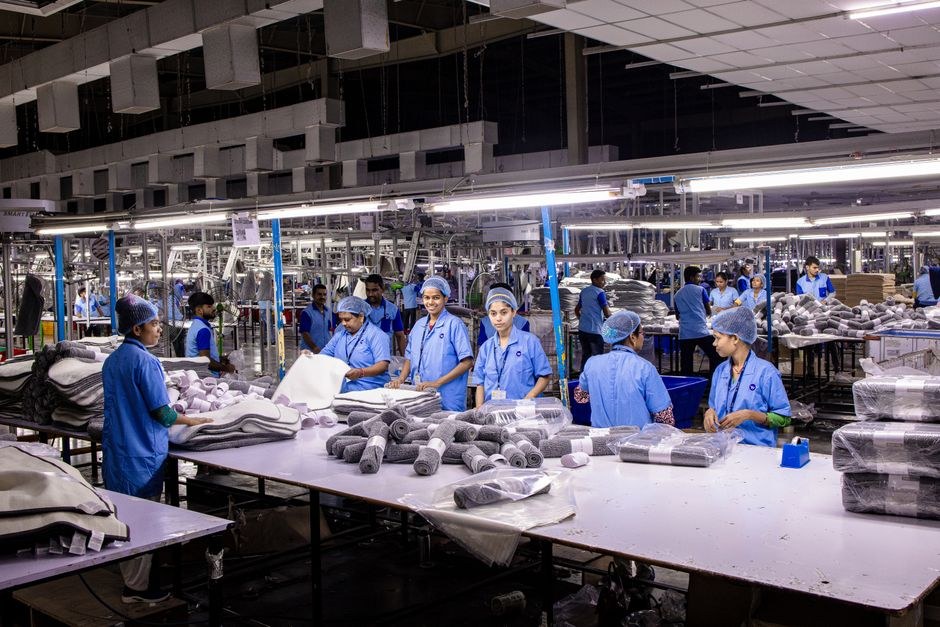
A buyer's walkthrough of cotton slipper production inside a Cixi slipper factory, from fabric cutting to final packing, and where orders quietly go wrong.
Most buyers never see the floor where their order is actually made. They approve a sample, sign a PO, and wait for a container. That gap is where surprises live — colour drift, sole hardness, late cartons. A walk through a Cixi slipper factory in Ningbo is the fastest way to understand what you are buying, and more importantly, which steps you should insist on signing off.
What Actually Happens in Cotton Slipper Production
Cotton slipper production is not one line. It is a sequence of eight or nine separate stations, and each one can be run well or run cheaply. The sequence itself rarely changes; what changes is how much inspection sits between the stations.
- Fabric inspection and relaxation. Rolls of cotton, terry and knit are checked for shade and width, then left to relax before cutting. Skipping the rest period is why uppers shrink after stitching.
- Cutting. Die-cut or CNC. Dies cost money and belong to whoever pays for them — confirm ownership in writing.
- Upper stitching. Cuffs, cross bands and moccasin seams are sewn here. Stitch density and thread type decide whether the slipper survives a wash cycle.
- Lining and fill. Plush, sherpa or knit lining is layered with memory foam or wadding. This is where comfort is decided, not in the showroom.
- Sole attachment. TPR, EVA or rubber soles are glued, stitched or moulded on. Sole bond is the number one failure point in returns.
- Lasting and shaping. Slippers sit on lasts to hold shape; weak lasting shows up as a collapsed heel.
- Trimming and cleaning. Thread ends, glue marks, lint. Small detail, big effect on shelf appeal.
- Packing. Polybag, hangtag, retail box, master carton, barcode. Last station, first thing your customer sees.
The Slipper Manufacturing Process, Step by Step, With the Questions to Ask
The slipper manufacturing process looks simple on a factory tour video and feels very different when 20,000 pairs are moving. Here is the practical version, with the questions worth asking at each stage.
- Material in-house. Ask how many days of fabric stock they hold and from how many mills. A single-mill dependency is your risk, not theirs.
- Cutting. Ask what the fabric utilisation rate is on your pattern. A two-point difference in waste is real money across a container.
- Stitching. Ask for the stitch-per-inch spec and whether it is written on the work ticket or only in someone's head.
- Foam insertion. Ask for density in kg/m³ and thickness in mm, and ask to see the incoming inspection record. "Memory foam" without a number means nothing.
- Sole bonding. Ask about surface preparation before gluing. A wiped and roughened sole holds; an unwiped one peels in a cold warehouse.
- Curing. Ask how long bonded pairs rest before packing. Packing too early traps solvent and softens the bond.
- In-line QC. Ask how many inspectors, at which stations, and what the rejection rate is against. A number pulled from the air is your signal.
- Final inspection. Ask for AQL level and whether you can send a third-party inspector. If the answer is a flat no, keep looking.
- Packing and carton drop. Ask for the carton compression test result. Slippers are light but bulky; weak cartons crush at the bottom of a stack.
Where Cixi Factories Differ From General Trading Offices
Cixi's advantage is clustering. Fabric mills, foam suppliers, sole moulders and carton printers sit within a short drive, so a mid-run change — a darker terry, a firmer sole — can be solved in days rather than weeks. A trading office in another city has to broker the same change by phone and loses that time.
That clustering also means the factory floor is closer to the sample room than buyers expect. Ask to see where your golden sample is stored. In a well-run plant it sits on a shelf next to the line, dated and signed. In a badly run one it has disappeared into an office drawer.
If a factory will not let you stand on the line and watch your own order run, the problem is usually not secrecy. It is that the line is running something else.
What to Walk Away With After a Factory Visit
A tour is only useful if it ends with documents, not impressions. Before you leave, collect these:
- A signed capacity statement: pairs per month, and how many lines can be dedicated to your order.
- The spec sheet for your product, with foam density, sole material and stitch count written down.
- Photographs of the carton, hangtag and polybag as they will actually ship.
- The name of the person accountable for quality, not just the sales contact.
Practical Advice Before You Place the Order
Treat the factory visit as a dry run for the order itself. If the tour is disorganised, the production will be too. Book the visit on a normal working day, not during a trade fair week when the floor is staged for guests.
Then lock the process down on paper. Agree the golden sample, the AQL level, the carton drop result and the inspection timing in the PO, not in a chat message. Budget for a pre-shipment inspection on your first two orders even if the factory has its own QC. Once three shipments land clean, you can relax the frequency — not before.
Finally, keep one rule in mind: the cheapest quote in Cixi and the most expensive one usually differ by work you cannot see. The tour is how you find out which work is missing.
Tags: cotton slippers, China sourcing, Cixi manufacturing, OEM slippers, quality control