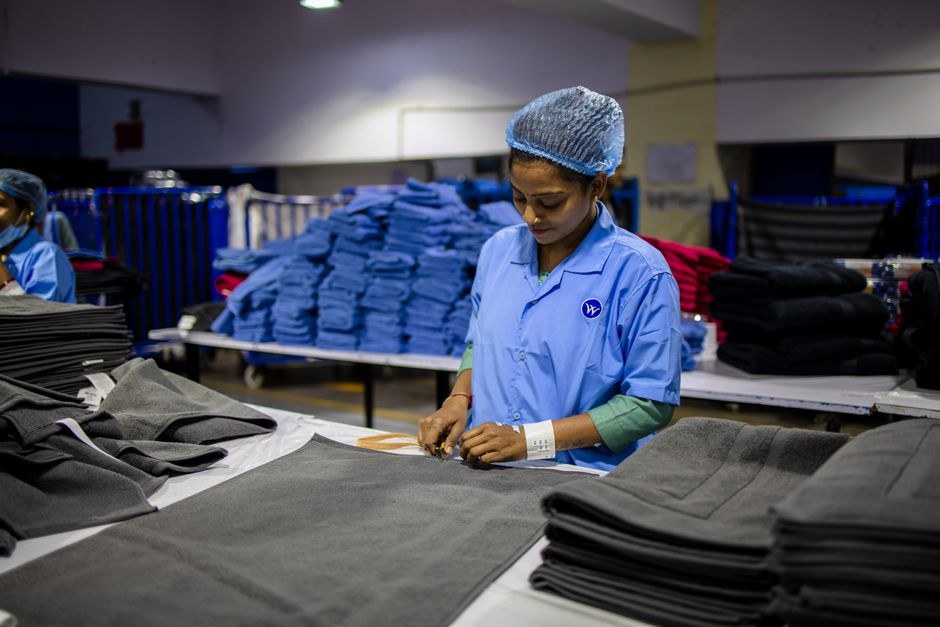
A final inspection alone is too late. Build a staged QC program for cotton slipper production with in-process checks at cutting, lasting, and packing.
A single pre-shipment inspection of a cotton slipper order is a post-mortem, not a control. By the time a third-party inspector opens cartons at the end of the line, the fabric has been cut, the soles have been bonded, and the defects are already repeated across thousands of pairs. A proper cotton slipper QC program is a series of gates across the production run, each with a defined check, an owner and a decision point. Below is how to structure one for wholesale cotton slippers, from a buyer's side of the factory gate.
Why final inspection alone fails in cotton slipper production
Slippers are assembled from soft, variable materials: cotton uppers, plush linings, memory foam inserts, TPR or EVA soles. Most defects are dimensional or alignment problems that compound. If the cutter runs fabric at the wrong grain, every upper in that lot will twist after lasting. If the lasting operator sets one side of the machine 2 mm off, one side of the order will sit loose on the foot. A final AQL inspection at 2.5 will catch an inflated defect rate, but it will not tell you why the parcel is failing, and it will not save the week of production that created it.
The practical consequence: a final inspection is a pass/fail verdict on a finished batch. In-process checks are where you still have room to cut losses. For an importer placing a 5,000-pair order, one wasted cutting lot can be a meaningful slice of the tooling-free margin, especially in pre-season windows when re-cutting pushes the shipment past the retail launch.
Stage 1: Incoming material checks before the cut
Start the slipper production quality control clock at goods-in, not at packing. Before any fabric is spread, ask the factory for the material lot record: fabric type, GSM, roll quantity, shade batch, and the supplier's test report on color fastness and shrinkage where relevant.
- Fabric and lining: verify GSM against the approved spec, check for shade variation between rolls, and confirm the lining has been brushed or bonded evenly.
- Memory foam: confirm density (kg/m3) and thickness against the approved sample; a common failure is foam arriving softer than specified, which shows up later as the slipper bottoms out.
- Soles: confirm compound type, hardness (Shore A), and dimensional tolerance; check the TPR or EVA batch for flash or sink marks.
- Trims and packaging: logo ribbons, labels, hangtags, polybags and carton prints — check artwork against the approved version, not a previous order.
A workable rule is to hold the cut until the material check is signed off. If a fabric roll is off-spec, it is still a roll, not 2,000 defective uppers.
Stage 2: In-process checks on the line
This is where in-process slipper inspection earns its cost. Instead of one end-of-line sample, the factory and your QC representative sample at defined stations: cutting, upper stitching, lasting, sole attachment, foam insertion, and final trim. Keep the checks small and frequent — for example, a first-off check at the start of each shift, followed by a patrol sample every couple of hours.
- Cutting station: check pattern alignment against the grain, panel symmetry, and that no two plies are shifted. Measure a few key panels against the pattern.
- Stitching station: check seam allowance, stitch density, loose threads, and whether the upper has been stitched to the correct size side (left/right symmetry).
- Lasting and sole attachment: check that the upper is centered, the sole is aligned to the heel, the bond line has no gaps, and the adhesive is not showing at the edge.
- Foam and lining insertion: check that the memory foam insert sits flat and full-length, with no bunched lining or exposed foam edge.
- Trimming and cleaning: check for adhesive residue, loose fiber, and dimensional creep — measure a sample against the size chart at least once per lot.
Have the factory log these checks with time, station, sample size and result. A log you can review between orders is worth more than a verbal assurance on the phone.
Stage 3: Final inspection and pre-shipment decisions
The final inspection still matters, but its job changes. Once in-process checks are working, the final AQL inspection is a verification of the system, not a hunt for the first defect. Sample per the agreed standard (2.5 or 4.0 for major defects, depending on your retail channel), classify defects as critical, major and minor, and inspect packed cartons as well as unpacked pairs.
- Verify measurement against the approved size chart, not just against the factory's internal chart.
- Check logo placement, embroidery or print registration, and label position against the approved golden sample.
- Check carton count, polybag seal, barcode scan and carton drop performance for the destination channel.
- Confirm that goods are packed to the correct SKU and colorway mix; mixed-carton errors are a frequent, expensive complaint from distribution centers.
Set the decision rules before the inspection starts: what defect rate triggers a re-inspection, what triggers a 100% sort, and who pays for the sort. A buyer who negotiates this at order confirmation has far more leverage than one negotiating at the container door.
Step 4: Put the QC program in the purchase order
The most common reason a QC program fails is that it lives in an email thread rather than the production agreement. Write the checkpoints into the PO or quality annex: station list, sample sizes, measurement tolerances, defect classification, golden sample retention, photo reporting, and the sign-off authority at each gate. For a seasoned Cixi factory these are familiar routines; ordering them in writing is what makes them enforceable.
On your side, keep three things in one file per SKU: the approved golden sample (signed and dated), the measurement sheet, and the QC log from the previous run. When you brief the next order, start from that file. Over two or three seasons this turns into a genuine cotton slipper QC program that catches problems at the cutting table instead of at the loading dock, and gives you a defensible record if an order dispute ever reaches the claim stage.
Tags: cotton slipper QC program, in-process slipper inspection, slipper production quality control, AQL inspection, wholesale cotton slippers