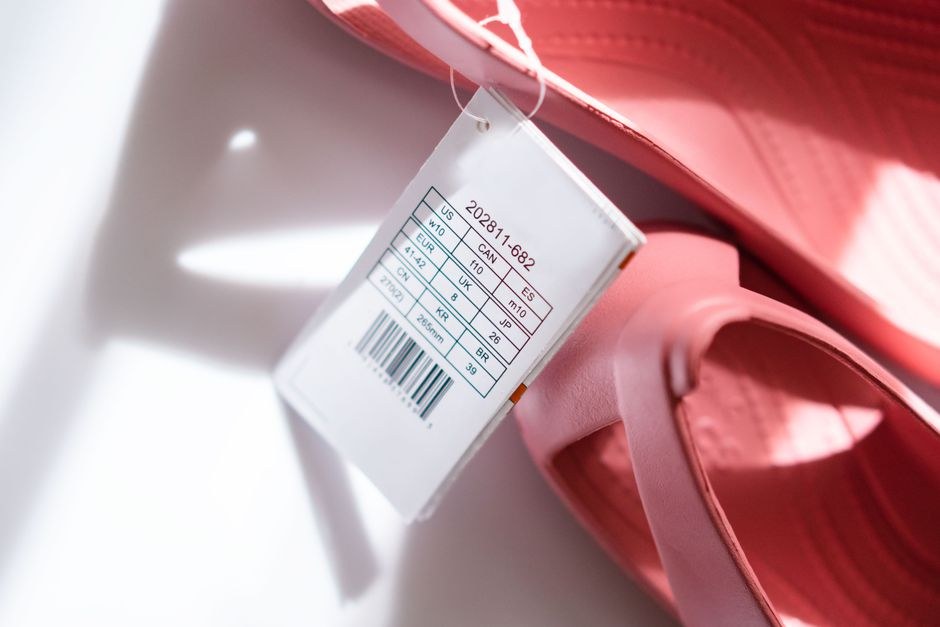
Size mismatches cause the most returns in slipper programmes. Here is how EU, US and UK size charts work for bulk wholesale orders.
Returns kill margin in a slipper programme: every pair that comes back costs you freight in both directions, repackaging labour and the shelf space it occupies while waiting for a credit note. This applies even when the factory's own QC is clean, because the failure happened at spec table stage. More often than not, bad slipper size chart alignment is behind a retail return rate that looks like a production fault but is not one.
Why indoor slipper sizes are not shoe sizes
Here is the core fact that trips up first-time buyers: a slipper is a soft-footwear category, not a shoe. It gets worn over bare feet, over socks, sometimes over a second pair of socks in a cold flat. It is graded on a last, but the last is padded, usually lined, and cut with far more tolerance than a leather shoe last. That makes slipper sizing for wholesale genuinely different from the shoe business.
Roughly speaking, a well-made cotton slipper runs about half a size larger than an equivalent leather shoe. If your buyers are comparing against footwear they already know, that half size is the one that matters. If you ignore it, you ship a size 40 slipper to a customer whose size 40 dress shoe fits snugly, and it will not be worn.
On top of that, the reference standard shifts by market. US sizes have shifted slightly larger over the last decade; continental European sizes have been relatively stable; UK sizing has drifted the other way in parts of the market. Older printed charts, or charts copied across from a shoe factory, are the single most common reason a perfectly good slipper arrives wrong.
Slipper sizing for wholesale: how to read a working chart
A working size chart is not one column. It needs at least four numbers per size: UK, US men's, US women's, EU, plus insole length in millimetres measured flat from toe to heel. Many buyers make the mistake of omitting insole length and treating it as optional; it is in fact the only figure that can be checked against a physical sample with a tape measure.
- EU size — the most commonly used anchor figure in European wholesale listings. It works best between 36 and 46.
- US men's / US women's — usually listed in two parallel columns, not one.
- UK size — often one size number lower than the equivalent US men's figure.
- Insole length (mm) — measured on a flat surface from toe tip to heel edge, not from the outer moulded edge of the sole.
Two extra columns also pay for themselves in practice: the intended foot-length window (say 245–252 mm), and the insole width at the ball of the foot. A slipper that is a half size correct in length may still be too narrow for a size 45 foot at the widest point, particularly on TPR or EVA soles with no give.
Before you settle on a chart, decide what percentage of your order is likely to be a half-size problem. In practice, a mid-size supermarket chain running a basic slipper line and a boutique running a spa-branded slipper will need to solve it very differently. Standardise the chart internally before the first PO, and never allow the chart to change mid-season.
Last dimensions and how they move through a bulk order
The insole does not describe the shoe; the last does. Lying under every bulk size are: length, ball girth, instep girth and heel width. If you are only ever sending the insole length to the factory and expecting the slipper to size itself, you are handing your sizing risk to the factory's existing last library. That is fine if the library matches your market. It is not fine if your market runs wider or narrower than the factory's default.
A simple sequence works better for bulk ordering:
- Send target market, foot length window and insole length in mm for every size.
- Request the factory's existing last chart, showing length, ball girth and last width at the joint. Do not accept a verbal answer.
- Order a pre-production size set — one pair per size, in the target last — and measure every pair on a bench in the same way you will measure production QC.
- Do not approve first bulk production from a photograph of a single size.
- For knit uppers, add expected stretch in the width direction; for felt and bonded fills, add compression that appears over the first few days of wear.
A sample pair can measure 265 mm on the bench and 262 mm after three days of wear if the upper relaxes over the board. Buyers rarely account for that, and it is worth a note in your spec for next season.
Hospitality, spa and promotional orders
For hospitality and spa orders, insole dimensions matter more than nominal sizes, because a guest with size 43 feet does not want to see a slipper labelled size 43 that has a 260 mm insole. Decide on your insole length window before you quote sizes, and set a tolerance for length — roughly ±5 mm on adult sizes is a usable working figure based on market norms, but verify against your own sample.
What to do before your next bulk order
Before issuing a PO, put your sizing decisions in writing and make the factory sign them off. The sign-off document needs five things:
- The full size chart per market, all columns populated.
- Insole length and ball width in millimetres for size run.
- The last chart that will be used for each size, including girth.
- Sample approval method: one pair per size, on a bench, measured and photographed.
- Production QC method: measure a sample per 500 pairs against the same chart.
Slippers are forgiving on style and unforgiving on fit. Almost everything else can be settled in the factory; the size chart has to be settled in your office. Fix it before your next PO, not after your next returns report.
Tags: slipper sizing, wholesale slippers, cotton slippers, EU UK US size chart, OEM slippers